CLFT
Global ViT features, fused while decoding. CLFT runs the camera image and a projected LiDAR image through the same vision transformer. Features captured from several transformer blocks become spatial maps; residual fusion combines the two modalities from coarse to fine.
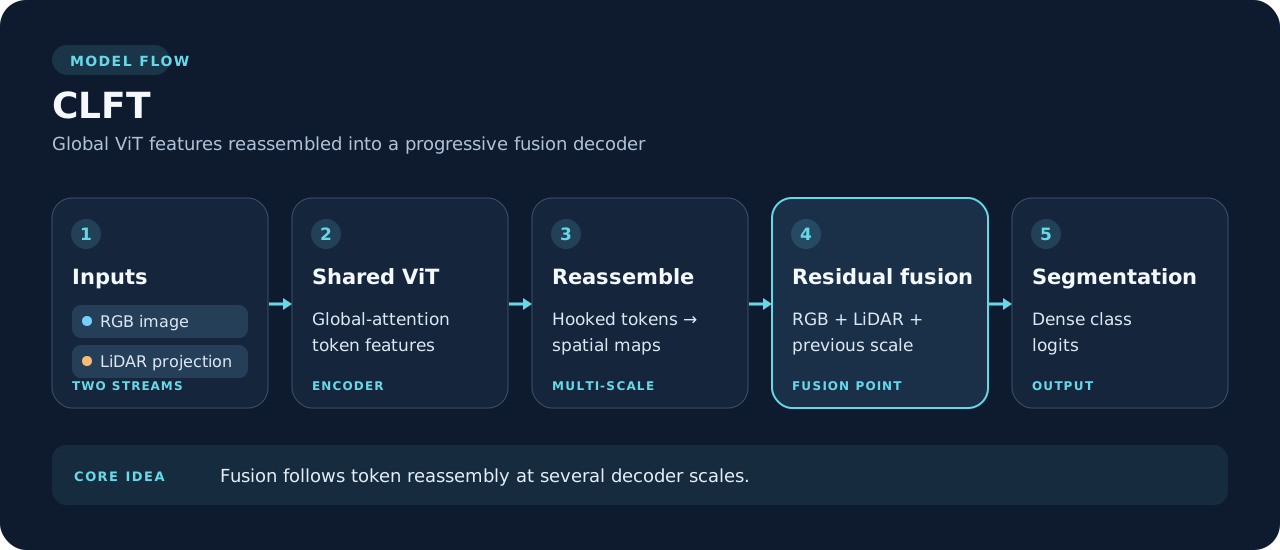
The highlighted card marks where the two streams meet. The diagram describes fusion mode; RGB-only and LiDAR-only modes use one stream.
Why choose it
CLFT uses global ViT attention and reassembles token features at several resolutions. It is the reference for comparing the hierarchical Swin design in CLFTv2. The library returns dense class logits; the underlying implementation can also produce a depth head, but the public CLFT wrapper exposes segmentation.
from visin_fusion.models import CLFT

model = CLFT(num_classes=4, image_size=384, mode="cross_fusion")
logits = model(rgb, lidar)  # [batch, 4, height, width]
rgb and lidar are image tensors; lidar is a projected image, not a raw point cloud. Set mode="rgb" or mode="lidar" for a single stream. See the library API for the common input and checkpoint contract.
Research references
- Gu, Bellone, Pivoňka & Sell, CLFT: Camera-LiDAR Fusion Transformer for Semantic Segmentation in Autonomous Driving, 2024. The camera–LiDAR fusion model behind this implementation.
- Tahves, Gu, Bellone & Sell, A Novel Vision Transformer for Camera-LiDAR Fusion based Traffic Object Segmentation, 2025. Extends CLFT traffic-object segmentation to more classes and evaluates it across varied weather conditions.
- Ranftl, Bochkovskiy & Koltun, Vision Transformers for Dense Prediction, 2021. Background for reassembling ViT tokens into multi-scale dense features.